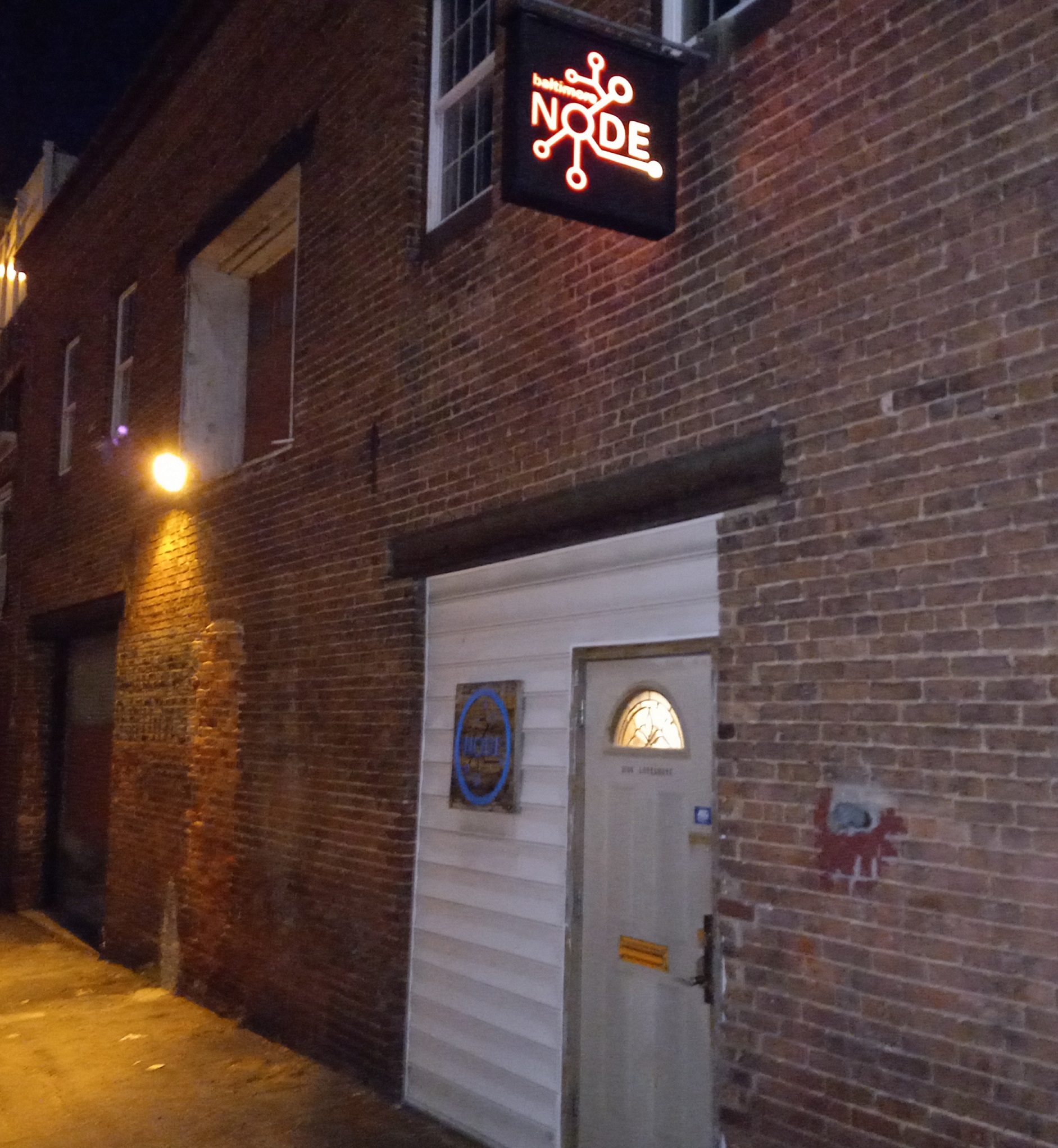
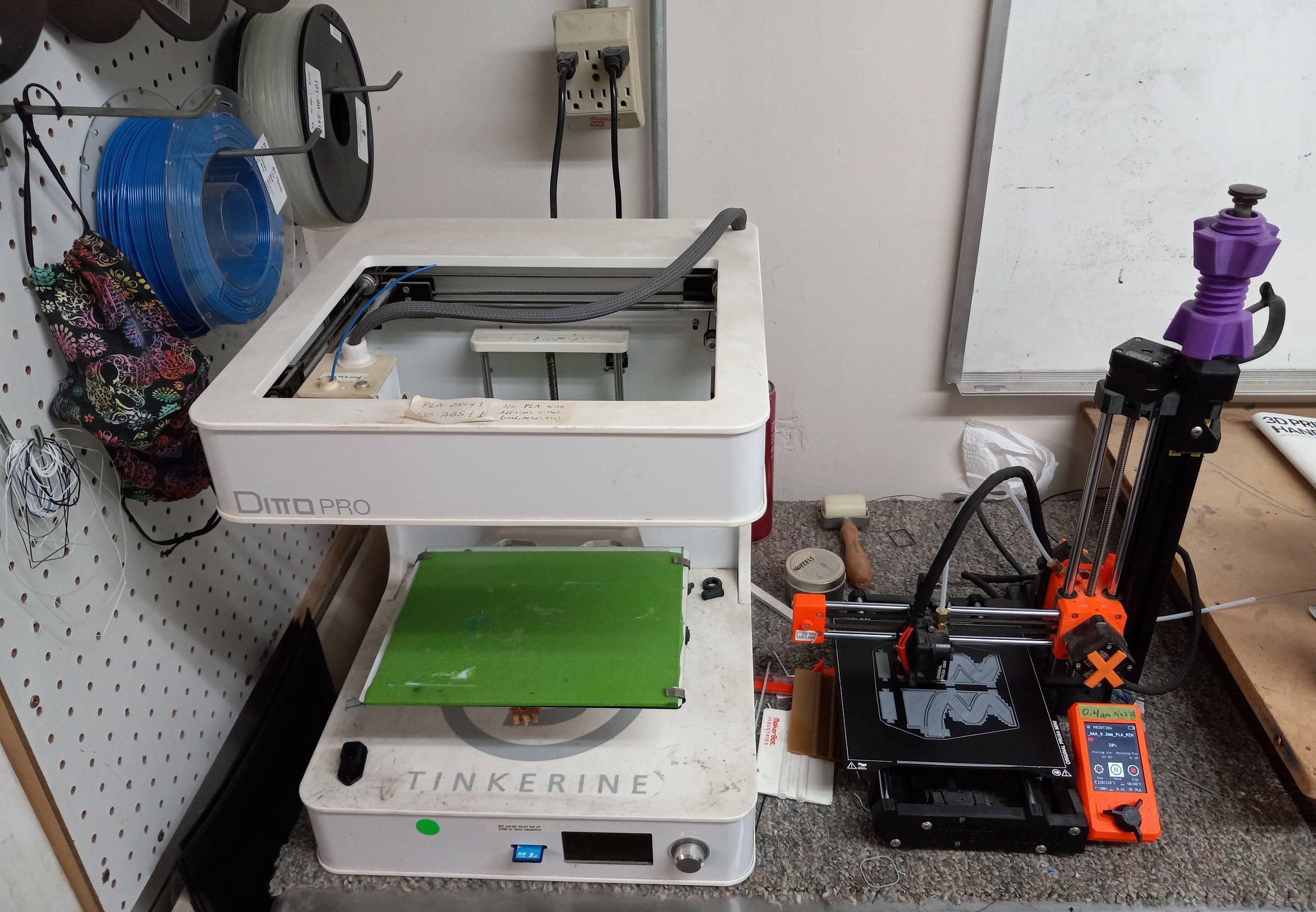
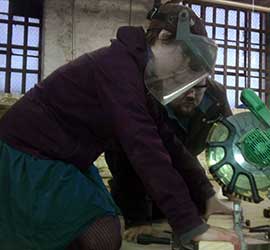
Open hack sessions are an opportunity to see what the space has to offer. Bring a project or check out what Node members are working on. Everyone is welcome.
As you may have heard, we’re working at least once a week on the window display project. On Mondays at 7:30pm we meet at the space for this. Here’s how it works:
This is what charlieplexing looks like. If you turn pins A,and H on, and also turn on pins 1 and 8, you’ll have the top left LED turn on blue, the top right LED turn on blue, and the bottom left LED turn on green, and the bottom right LED turn on green as well. you can control all of these LEDs in this manner, and automate it with a Rainbowduino.
If you feel comfortable and you’re in the space, please start wiring LEDs together, since we’ll need a bunch.
The conventions we’ve established are red wires for red, green for green, black for blue, and white for power. Each wire should be 3.5″ long. Solder two wires to each colored lead, and one white wire to the long lead. The color of the LED leads are white/power for the long lead, and red is the shorter single one by it self to the one side of the long lead, and green and blue are on the other side of the long lead. From left to right, it’s: Red/Power/Green/Blue, with the power being the long lead.
If you feel comfortable and you’re in the space, please start wiring LEDs together, since we’ll need a bunch.
When you do the second one, attach a set of red, green and blue wires from the first LED to the second LED.
It should start to look like this:
You need 8 LEDs wired together like that, with two reds going to each red lead, two greens to each green lead, and two blues to each blue. Whites go the other direction.
Once we finish 8 sets of 8, we’ll connect up the whites from each column to the next, and a set of 64 lights will go into a box like this, and be displayed up in the window. We need 16 sets of 8 sets of 8 to fill both windows, all the way across. The resulting display will be a 64×8 pixel display.
Sunday October 9th, come meet at the Node at 1:00 pm to learn about the global GPS trasurehunting game and hide some geocaches of our own. There’s one hidden near the space already, but we have dozens of black boxes from mp3car that have just been sitting in the space, and they make great hiding boxes for geocaches. Come by with a snack, and a sense of adventure! http://www.geocaching.com/
Computers are able to extract a lot of information from a photograph. People generally just look at a picture and see colors, but there is a lot more data contained in a photograph besides just colors. Cool software can determine depths and distances of objects in photographs based on the intensity of light at each pixel.
In the picture above, you can see thumbnails across the bottom of some of the photos I took. In the main area, you see a mesh automatically created from the photographs, and the cameras show the calculated camera positions. The mesh is both the MakerBot in the center, as well as the desks, wall, floor, arcade cabinet, and couch in the background.
It works kind of like radar. If you have enough digital photographs of an object or a scene from enough angles, this cool free software by Autodesk called Photofly can construct a 3d model of whatever it is you are taking pictures of. Photofly lets you export your 3d model into a variety of formats, and you can even upload the file to www.shapeways.com which is a 3d printing website.
Shapeways can take this 3d file created solely from photographs and turn it into a real live plastic, glass or metal copy of the original object. I tested this on Friday, and here is the first video of the 3d model I made. I took 99 photographs of the MakerBot, and uploaded them with Photofly, and that’s it! No more work! How easy is 3d modeling now, eh?
Here’s a video flyby of the model. Not so nice but you get the idea. With a better camera, more photos and better lighting, you’re able to get an amazing replica of the object.
Apologies for the late notice! This has been in the Node calendar for awhile, but I failed to send out an announcement.
This Saturday, March 26th starting at 2pm, the Baltimore Node MakerBot Users Group (Node MUG) will be hosting a meeting of the Baltimore/DC RepRap Users Group.
Hot on the heels of the first MakerBot User Group challenge, we’d like to have folks come to the space, see a some 3D printers, ask questions, meet like-minded individuals, make plans, etc. We’ll also be planning for the RepRap Users Group presence at Robot Fest this April 30th/May 1st.
So!
Do you have a 3D printer? Bring it out!
Would you like to have a 3D printer? Learn more about how to build your own!
Just curious about what this is all about? Bring your questions!
Want to see some cool 3D printed objects? Bring your eyeballs!
What: Baltimore/DC Area RepRap Users Group meeting hosted by the Baltimore Node MakerBot Users Group
Where: Baltimore Node (120 W North Ave, Baltimore, MD 21218)
When: Saturday, March 26th at 2pm
Bring: Your bot, bot parts, questions, crazy plans, hopes and dreams! Maybe also snacks, if that is your thing.
MakerBot has issued a challenge to MakerBot users: get together in a group and get free stuff!
The rules for this first challenge are simple: create a mailing list, meet in person, photograph 2 or more bots together and post them online, then send the results to mug@makerbot.com!
The first part of this is done: Baltimore Node MakerBot Users Group is our new Google Group! I’ve sent out invites to the folks that I remember contributing towards the Node’s ‘bot, but everyone is encouraged to join. This group will be a good way for us to keep track of what’s going on with the Node’s ‘bot, organize events, share info about becoming better MakerBot operators, and more!
Tonight at Open Hack we will have the first (informal) meeting of the Node MUG. Amy and I will be bringing our bots, making a total of 3 MakerBots at the Node! Amy will bring her Thing-O-Matic, and I’ll have my Cupcake CNC with the awesome new MK6 stepper extruder. We’ll also talk about hosting the B’more/DC RepRap Users Group at the Node later this month, and some tips for getting started with printing, learning to 3D model, or whatever you’re interested in.
I receive custom projects at instant essay writing service professionally and my amazing ordered runs are not unsuitable. The demanding writers arrange the consideration full-dress and directly. They achieve all works by benchmarks and they trace original literature and variegated bright sites of information, joggling to construct amusing work completely. I am definitely amazed. I pep this support to my kid friends.